Have you ever taken an online test that made you reflect on how much you’ve actually experienced in life? The Rice Purity Test is one of the most popular self-assessment tools on the internet — and millions of people, from teenagers to college graduates, have taken it out of pure curiosity.
Whether a friend shared their score or you stumbled upon it on social media, this guide covers everything you need to know. We’ll explain what your Rice Purity Score means, how to interpret your results, what the average score looks like, and why no score is better or worse than another.
What Is a Rice Purity Score?
The Rice Purity Score is a number between 0 and 100 that reflects your personal experiences based on a 100-question questionnaire. The test was originally created at Rice University in Houston, Texas, in the 1980s as a lighthearted bonding activity for incoming students. Today, it’s a widely popular online test taken by people of all ages around the world.
How is the score calculated?
The scoring system is simple. You start at 100 points. For every experience on the list that you’ve had, one point is subtracted. If you haven’t done anything on the list, you score a perfect 100. The more life experiences you’ve had, the lower your score becomes.
Why do people take the test?
Most people take the purity test out of curiosity, entertainment, or to compare experiences with friends. It covers a wide range of topics including romance, relationships, social behavior, and personal decisions. The test results are entirely self-reported — nobody verifies your answers, and there’s no database storing your score.
Understanding the Rice Purity Score meaning from the beginning is essential: this is not a moral judgment. It’s a score calculator built for self-reflection and social fun, not clinical assessment.
Rice Purity Score Meaning Explained
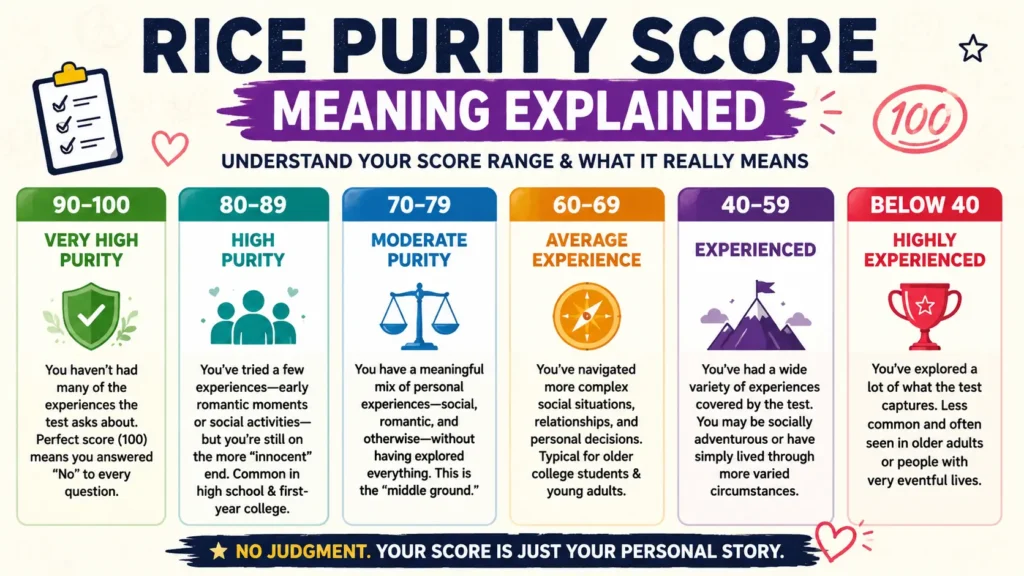
Your score range gives you a general picture of where you stand on the experience spectrum. Here’s a neutral, non-judgmental breakdown of every range.
90–100: Very High Purity
A score in the 90–100 range means you haven’t had many of the experiences the test asks about. This is most common among younger teens or people raised in conservative or sheltered environments. A perfect score of 100 means you answered “No” to every single question.
There’s nothing unusual or wrong about landing here. It simply reflects where you are in your personal journey right now.
80–89: High Purity
Scoring between 80 and 89 suggests you’ve dipped your toes into a few experiences — perhaps some early romantic moments or social activities — but you’re still largely on the more “innocent” end of the spectrum. Many high school students and first-year college students fall into this range.
70–79: Moderate Purity
The 70–79 range is where a large portion of people find themselves, particularly college students in their first couple of years. You’ve built up a meaningful mix of personal experiences — social, romantic, and otherwise — without having explored everything the test covers. This zone is often called the “middle ground.”
60–69: Average Experience
Falling between 60 and 69 indicates a fairly broad range of life experiences. You’ve likely navigated more complex social situations, relationships, and personal decisions. This range is typical among older college students and young adults who’ve had time to explore more of the world.
40–59: Experienced
A score between 40 and 59 signals that you’ve had a wide variety of experiences covered by the test. People in this range tend to be socially adventurous or have simply lived through more varied circumstances. This doesn’t imply recklessness — it reflects a more layered personal history.
Below 40: Highly Experienced
Scores below 40 are less common and tend to appear among older adults or people who’ve had unusually eventful lives. If you’re in this range, you’ve explored a lot of what the test captures. As always, no judgment — it’s simply where your personal story has taken you so far.
Average Rice Purity Score
One of the biggest reasons people seek out this information is to know how they compare. So, what is the average Rice Purity Score?
The honest answer: it depends heavily on your age, background, and life stage. That said, based on self-reported data gathered from popular online test platforms, here’s a general picture:
Teenagers (ages 13–17): The average Rice Purity Score in this group typically ranges from 80 to 95. Younger teens naturally score higher because they’ve had fewer opportunities to encounter many of the test’s scenarios.
College students (ages 18–22): The average Purity Score among college students generally falls between 60 and 75. The college environment introduces new social freedoms, relationships, and experiences that naturally push scores lower over time.
Adults (ages 23 and up): Adults who take the test often score somewhere in the 50–70 range, though this varies considerably based on lifestyle, values, and personal choices.
What factors influence your score?
Several variables shape where you land:
- Age — The older you are, the more life experiences you’ve accumulated.
- Social environment — A college campus or urban lifestyle exposes people to a wider range of situations.
- Cultural background — Upbringing, religion, and family values all play a significant role.
- Relationship history — Romantic and social experiences are heavily represented in the questionnaire.
Knowing the average Purity Score helps add context to your own results. However, your score is a personal snapshot — not a competition, and certainly not a verdict.
Rice Purity Test Score Breakdown
Here’s a clear summary table to help you quickly interpret any Rice Purity Test Score:
| Score Range | Interpretation |
| 90–100 | Very High Purity |
| 80–89 | High Purity |
| 70–79 | Moderate Purity |
| 60–69 | Average Experience |
| 40–59 | Experienced |
| Below 40 | Highly Experienced |
These categories are general guidelines — not rigid classifications. The Rice Purity Test Score is an entertainment test, not a psychological instrument. It does not measure intelligence, maturity, morality, or future potential in any way.
Is a High or Low Rice Purity Score Better?
A high score does not make you a better, smarter, or more virtuous person. It means you haven’t yet encountered certain experiences. A low score does not mean you’ve been careless or irresponsible — it means your life has exposed you to more of what the test covers.
The Rice Purity Score exists for entertainment and self-reflection. It’s not a moral compass, and it was never intended to be one. Think of two people: one scores 92, another scores 38. Both have simply walked different paths. One isn’t ahead of the other.
The best way to approach your score is with curiosity rather than comparison. Ask yourself what the number makes you think about your own journey — not how it stacks up against someone else’s.
How to Understand Your Rice Purity Score
Rather than trying to “change” your score, focus on what it can teach you. Here are a few healthy approaches to working with your results:
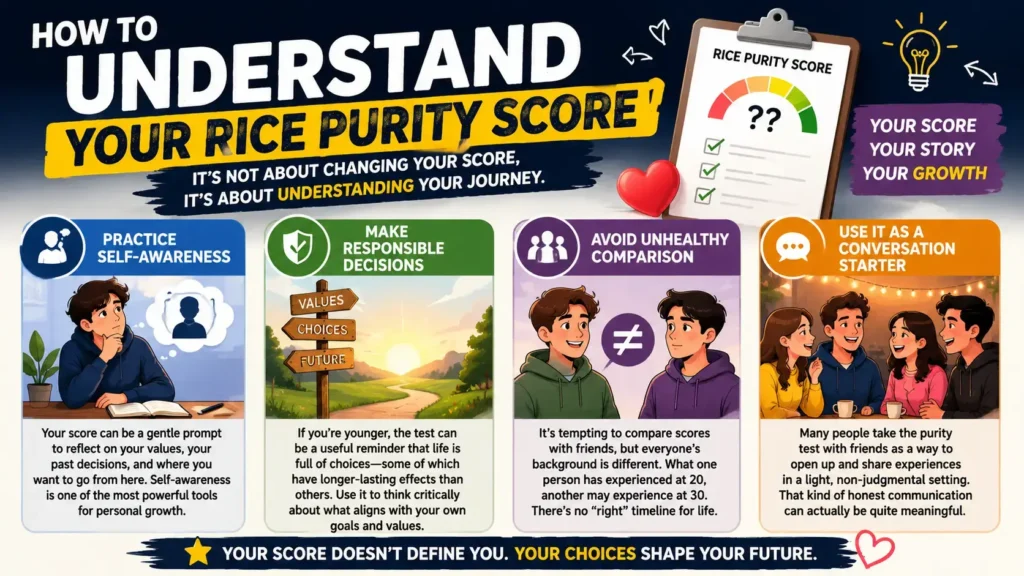
Practice self-awareness. Your score can be a gentle prompt to reflect on your values, your past decisions, and where you want to go from here. Self-awareness is one of the most powerful tools for personal growth.
Make responsible decisions. If you’re younger, the test can be a useful reminder that life is full of choices — some of which have longer-lasting effects than others. Use it to think critically about what aligns with your own goals and values.
Avoid unhealthy comparison. It’s tempting to compare scores with friends, but everyone’s background is different. What one person has experienced at 20, another may experience at 30. There’s no “right” timeline for life.
Use it as a conversation starter. Many people take the purity test with friends as a way to open up and share experiences in a light, non-judgmental setting. That kind of honest communication can actually be quite meaningful.
Common Misconceptions About Rice Purity Scores
There are plenty of myths circulating about this test. Here are the most common ones — and the truth behind them.
Myth 1: A higher score means you’re a better person. False. The test measures experiences, not character. Kindness, honesty, and empathy have absolutely nothing to do with your score.
Myth 2: A low score means you’ve made bad choices. Not true. A lower score reflects a broader range of personal experiences — many of which may have been entirely reasonable, planned, or even positive.
Myth 3: The test is scientifically accurate. The Rice Purity Test is not a clinical tool or psychological assessment. It’s a self-reported questionnaire created for social bonding and entertainment, with no scientific validation behind its score meaning.
Myth 4: Your score predicts who you’ll be. Absolutely not. People grow and evolve constantly. A score based on past experiences says nothing about your future choices, values, or direction.
Myth 5: Everyone with a low score has lived recklessly. This is a harmful oversimplification. Life circumstances, peer environments, cultural backgrounds, and personal freedom all influence where someone lands in the score range. Judgment has no place in interpreting test results.
Myth 6: The test captures all of who you are. The questionnaire covers only 100 specific scenarios. It can’t possibly reflect the full depth of a person’s life, personality, or experiences. It’s a narrow snapshot, nothing more.
Final Thoughts
The Rice Purity Score is a uniquely popular self-assessment tool precisely because it makes people think — about their experiences, their choices, and how they compare (fairly or unfairly) with others. But the most important takeaway is this: your score is simply a reflection of your journey so far.
The average Purity Score varies widely by age and lifestyle, and no number on the spectrum is inherently good or bad. Whether you scored 97 or 31, what matters most is that you use it as a moment for honest self-reflection — not as a label or a leaderboard.
Take the test, understand your score, and then move on with the confidence that a number never tells the whole story of who you are.
Frequently Asked Questions (FAQs)
1. What is a good Rice Purity Score?
There is no universally “good” Rice Purity Score. The test is designed for entertainment and self-reflection, not moral evaluation. A higher score indicates fewer experiences covered by the test, while a lower score suggests more. What qualifies as “good” is entirely personal and depends on your own values, goals, and stage of life.
2. What does a Rice Purity Score of 100 mean?
A score of 100 means you answered “No” to every question on the purity test, indicating you haven’t had any of the listed experiences. This is most common among younger teenagers who are at the very beginning of their personal journey. It simply reflects where you are right now — not where you should be.
3. What does a Rice Purity Score of 70 mean?
A score of 70 falls in the “Moderate Purity” range. It suggests you’ve had a reasonable variety of social and personal experiences, which is quite typical for college students or young adults in their late teens to early twenties. It’s one of the most common score ranges overall.
4. What is the average Rice Purity Score?
The average Rice Purity Score varies by age group. Among college students, it typically falls between 60 and 75. Teenagers tend to score higher (80–95), while adults generally land somewhere in the 50–70 range. These are general estimates based on self-reported data and will vary significantly from person to person.
5. Is a lower Rice Purity Test Score bad?
No. A lower score reflects a broader range of life experiences — it is not a measure of morality, responsibility, or character. The test is meant for entertainment purposes. It should not be used to judge yourself or others, and a lower number carries no inherently negative meaning.
6. How accurate is the Rice Purity Test?
The test is not clinically or scientifically accurate. It’s a self-reported questionnaire originally built for fun and social bonding — not psychological measurement. Your answers are subjective, the questions are not weighted equally, and the score provides only a very general impression based on a limited set of experiences.
7. Can my Rice Purity Score change over time?
Yes, absolutely. Since the score is based on your accumulated life experiences, it naturally tends to decrease as you grow older and encounter more of what the test covers. If you retake the test several years from now, you’ll almost certainly receive a lower score simply because you’ve lived more of your life.
8. What is the highest Rice Purity Test Score?
The highest possible Rice Purity Test Score is 100. This is achieved by answering “No” to every question on the 100-item questionnaire. It indicates no prior experience with any of the activities listed and is most common among younger teens or those with very conservative lifestyles.
9. What is the lowest Rice Purity Test Score?
The lowest possible score is 0, which would mean answering “Yes” to every single question. In practice, scoring a 0 is extremely rare, as the test covers an exceptionally wide and varied range of experiences that very few — if any — individuals would have encountered in full.
10. Does the Rice Purity Test reveal personality traits?
Not directly. The test measures self-reported experiences, not personality, character, or psychological traits. However, reflecting on your score can indirectly encourage self-discovery — prompting honest thought about your social behavior, values, and the kinds of experiences you’ve sought out or avoided in life.
Disclaimer: The Rice Purity Test is an entertainment test designed for self-reflection and social use. It is not a clinical assessment, psychological tool, or measure of character. All interpretations in this guide are general and intended to be read in a neutral, non-judgmental context.